The Renewable Energy Revolution — Walking the Wind, Solar & Karst Landscape of Korlat
From the Novigrad Sea to Croatia’s first renewable hybrid energy park, a field journey through Ravni kotari, wind turbines, solar trackers and the changing Dalmatian landscape.
▶️ Rave the World Radio
24/7 electronic music streaming from around the globe
the Tuesdays 4 Climate Revolt ·
The Renewable Energy Revolution
Energetski park Korlat, in the village of Korlat, about eight kilometres northwest of Benkovac on the D27. HEP’s 58 MW wind farm has been operating since 2021. SE Korlat, the solar plant on the same site, entered regular operation in June 2026. Together they form Croatia’s first hybrid renewable park. Ravni kotari is the landscape where that sentence becomes a walk.
The revolution, if that is the word for a Tuesday, does not start at the substation. It starts the night before, in Posedarje, on the Novigrad Sea, with palms under a hard lamp and a beach that goes black beyond the railing. In the morning the turbines are already there, thin and white, on the ridge across the water. You can see the park before you have walked a step toward it. That is the point of going.
Ravni kotari is the real energy landscape. The brochure is a caption. The karst is the plant.


I. What the Tuesday is for
Tuesdays 4 Climate Revolt is a field season, not a press conference. The theme for 22 September 2026 is the renewable energy revolution, and the meeting place is Energetski park Korlat: the village of Korlat, about eight kilometres northwest of Benkovac, reached from the D27. The instruction is ordinary and strict. Go to the machines. Stand where the wind farm and the solar plant occupy the same plateau. Learn the wattage the way you learn a path: by being on it.
A hybrid park is a simple idea that the ground makes complicated. Wind and sun do not fail on the same afternoon as often as either fails alone. The wires, substation, and access road provide shared infrastructure for the hybrid park. The second plant arrives as a tenant. At Korlat the tenant is large. HEP’s wind farm is 58 MW and has been in operation since 2021. SE Korlat, the photovoltaic plant built across the same site, is sized at up to 99 MWp of panels and a 75 MW connection to the grid. It entered regular operation in June 2026. HEP describes the pair as Croatia’s first hybrid renewable park of this kind, and the solar half as the largest photovoltaic plant yet built in the country.
Those numbers are not a mood. They are the reason the Tuesday exists. Ravni kotari, the flat limestone country of northern Dalmatia, is where the numbers have been poured into concrete, steel, and a fence you can walk up to.
“We are fools.”
Professor Goran Krajačić, PhD, of the Faculty of Mechanical Engineering and Naval Architecture at the University of Zagreb, said that on HRT’s Studio 4, talking about the habit of leaning on fossil fuels. He did not stop at the insult. There had been, he said, “enough oil crises for us to have learned that dependence on fossil fuels drives up prices and causes inflation, while also jeopardizing security of supply and the functioning of society.” The Korlat Tuesday is one answer to that sentence: a wind farm that has been turning since 2021, and a solar plant that entered regular operation in June 2026 on the same ridge, in a country that already knows what an oil shock feels like.
II. The ridge from the beach
Posedarje sits on the Novigrad Sea. From the shore at first light the far side is a dark band and a peach sky. A few minutes later the band grows a comb of turbines. They are small. They are unmistakable. The same machines the walk will reach in the afternoon are already a horizon from the place you slept.
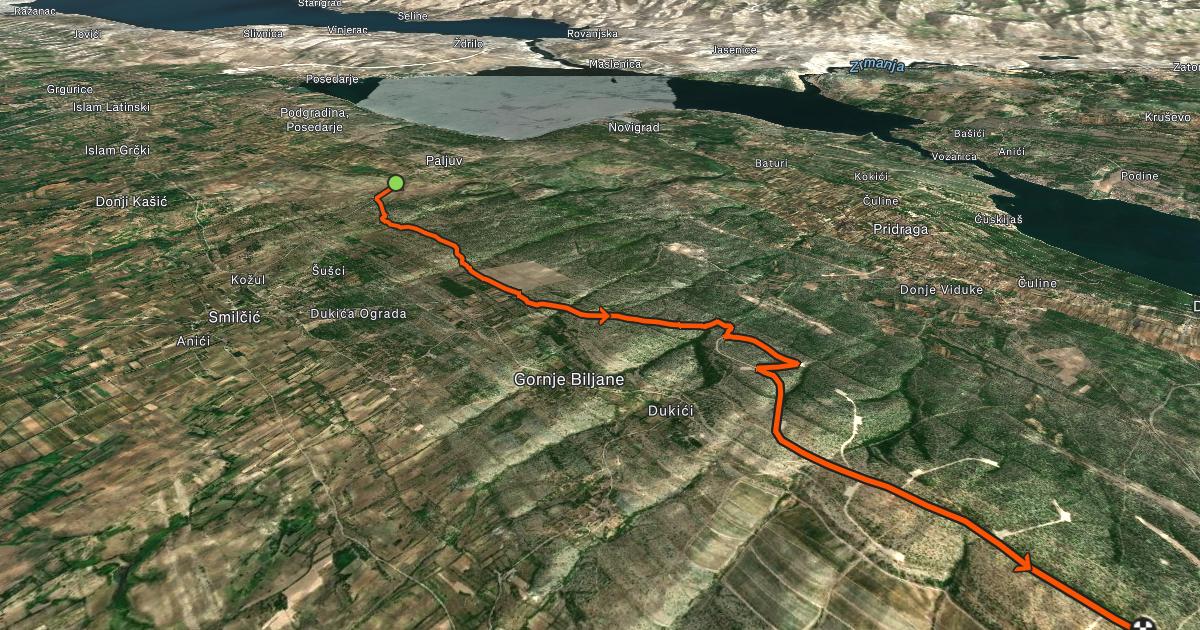
That view does a kind of work a map does not. Korlat is inland, southeast of the sea, up on the plateau above Benkovac. It is not a secret installation in a forest concession. It is a skyline. The night in Posedarje and the morning on the beach are the approach: the revolution, so called, is visible from a towel and a pair of wet shoes. Later, on the OsmAnd track, it becomes a destination with a kilometre count.
III. Paljuv to the plateau
The recorded walk starts at Glavica in Paljuv, late morning, and ends at the park in the middle of the afternoon. About 11.3 kilometres. The phone’s elevation is jumpy, so the honest figure is the shape of the line, not a heroic climb total: it leaves the hamlets near 200 metres and finishes on the Korlat plateau around 360. The villages in between are the ordinary ones of this corner of Zadar County. Buterini. Smilčić. Gornje Biljane, and the grounds called Dukića Ograda and Dukići, where the turbines stop being a rumour and become towers over juniper.
The path is a karst lane. Pale stone, two ruts, maquis closing and opening. A young pine in a clearing. A transmission pylon before the wind farm, which is the honest order of things: the grid arrives in the photograph first. Pink berries on a shrub beside the track. Smoke bush in seed, the fluffy heads Dalmatians call ruj, backlit on the open ground above Smilčić. A planted grid of young trees on the plain at Gornje Biljane. Then the scrub wall, and the first close machine, and the track that runs up to a tower as if the tower were a road sign.
None of this is scenery pasted around an energy story. It is the energy story. The plateau was maquis and dry grass and a power line before it was a park. The park occupies a ridge within an already working landscape of stone, scrub, olives in the villages below, and long sightlines toward Velebit. Walking it is how you stop treating “renewables” as a logo and start treating them as a land use.
IV. The dossier
Say the plant in the units it was built in. Energetski park Korlat sits in Ravni kotari, in the territory of the Town of Benkovac, about a kilometre northeast of the village of Korlat and about eight kilometres northwest of Benkovac itself, with access off the D27. The investor on the solar side is Energetski park Korlat d.o.o. The wind farm is HEP’s first wind farm, operating since 2021.
| Piece | What is on the ground |
|---|---|
| Wind | VE Korlat, 58 MW, onshore, in operation since 2021. HEP’s first wind farm. |
| Solar | SE Korlat, up to 99 MWp of panels, 75 MW at the grid connection. Regular operation since June 2026. |
| Trackers | Single-axis rows that follow the sun. 157,000 photovoltaic modules on single-axis tracking structures. |
| Land | About 150 hectares inside the wind farm’s ground. Ravni kotari. |
| Yield, solar | HEP’s figure: about 165 GWh a year, with the hybrid park described as capable of meeting the electricity needs of around 100,000 households. |
| Money | About €70 million for the solar plant, financed with EBRD and EIB loans. |
| Wires | The existing 33/110 kV Korlat substation. Wind and solar leave by the same gate. |
Trial operation is not a ribbon. It is the plant running while the paperwork and the punch-list are still alive. By the Tuesday of this walk, the panels were already a dark field you could photograph from outside the fence, with a blade turning above them. That is what a newly operational hybrid park looks like when you are standing in the gravel: not a rendering. A tracker row, a green post, one white blade in the corner of the frame.
Croatia’s first hybrid park is a fence line you can walk to from Paljuv before lunch is a memory.
V. Hybrid, said in karst
Hybrid here means shared land and shared grid, not a metaphor. The wind farm was built first. The solar plant was drawn onto the ground the turbines already occupied, the development of SE Korlat having started in 2019 while VE Korlat was still being prepared. The bet is complementarity. A windy period and a sunny period can complement one another, although both resources remain weather-dependent. The shared substation connects both renewable sources to the grid. For a country whose renewable argument has often been “the coast is windy and the south is bright,” Korlat is the argument built once, in one municipality, instead of twice in two press releases.
Ravni kotari makes the argument visible because the country is open. From the D27, from the villages, from a ploughed field in the evening after the track has ended, the turbine row is still on the ridge. The solar field does not hide. A 150-hectare tracker layout on pale gravel cannot pretend to be a hedge. That exposure is a political fact. People who live here do not meet the energy transition in a ministry PDF. They meet it as a change in the skyline they already used for weather.
There is a transmission pylon on the walk in, and there is a fence at the end. Both belong in the essay. The revolution people are invited to applaud still has a lock on the gate and a tower that belongs to the transmission company. Public kilowatt-hours move through ordinary, ugly, necessary hardware. A Tuesday that only photographs the blade against blue sky has edited out the post, the motor, the substation, and the lock. A Tuesday that walks the whole line gets all of it: juniper, berries, a young pine, the pylon, the tower, the panels, the fence.
VI. After the recording stops
The OsmAnd line ends at the park in the middle of the afternoon. The day does not. Later, a ploughed field in the plain still has the Korlat turbines on the far ridge, small and exact, as they were from Posedarje at dawn. The same machines, two distances. Morning: a comb on the horizon across the Novigrad Sea. Evening: a comb on the horizon beyond trees and turned earth. Between them, eleven kilometres of karst and the fact of having stood under one tower.
That repetition is the essay. Renewable energy in Ravni kotari is not a campus you visit and leave outside the photograph. It is a horizon that survives the walk. You can ignore it from the beach and still be looking at it. You can finish the track and still be looking at it from a field that has nothing to do with the tour. The landscape has already been revised. The revision is 58 MW of wind since 2021, and a solar plant operating on the same site since June 2026, and HEP’s first wind farm here rather than in a more convenient picture.
VII. What to do with a Tuesday
Print the dossier. Walk the line if you can, from Paljuv, and do not start the story at the visitor angle. Start it where the turbines are still a rumour on a ridge, and end it where the panels have a motor and a lock. If you cannot walk it, refuse the softer sentence anyway. “The renewable energy revolution” is a title. Energetski park Korlat is a place. Ravni kotari is the country that place sits in: limestone, villages, a state road, a sea you can look back toward, and a skyline that now includes the machines on purpose.
HEP’s own project page for the solar plant is the spec sheet. The photographs are the spec sheet with dust on it. Use both. A revolution you cannot locate on the D27 is a slogan. A hybrid park you can see from Posedarje before breakfast is a landscape, and landscapes are what Tuesdays are for.
References
Goran Krajačić, Croatian Radiotelevision at Studio 4: Professor Goran Krajačić, PhD, Faculty of Mechanical Engineering and Naval Architecture, University of Zagreb, on reliance on fossil fuels. “We are fools.” Enough oil crises, he said, to have learned that dependence on fossil fuels drives up prices and causes inflation, and jeopardizes security of supply and the functioning of society.
HEP — Korlat Solar Power Plant: project sheet for SE Korlat, including the hybrid park, the 99 MWp / 75 MW figures, the tracker layout, the Benkovac location, and trial-operation timing. (HEP Korlat SPP)
Field photographs, 21–22 September 2026: Posedarje, the Novigrad Sea, the walk from Paljuv through Smilčić and Gornje Biljane, and the fence line at the park. The straightened frame of the fence, panels, and one blade is the public photograph. (Fence, Panels, And One Blade)

Comments
Post a Comment